Spotlight
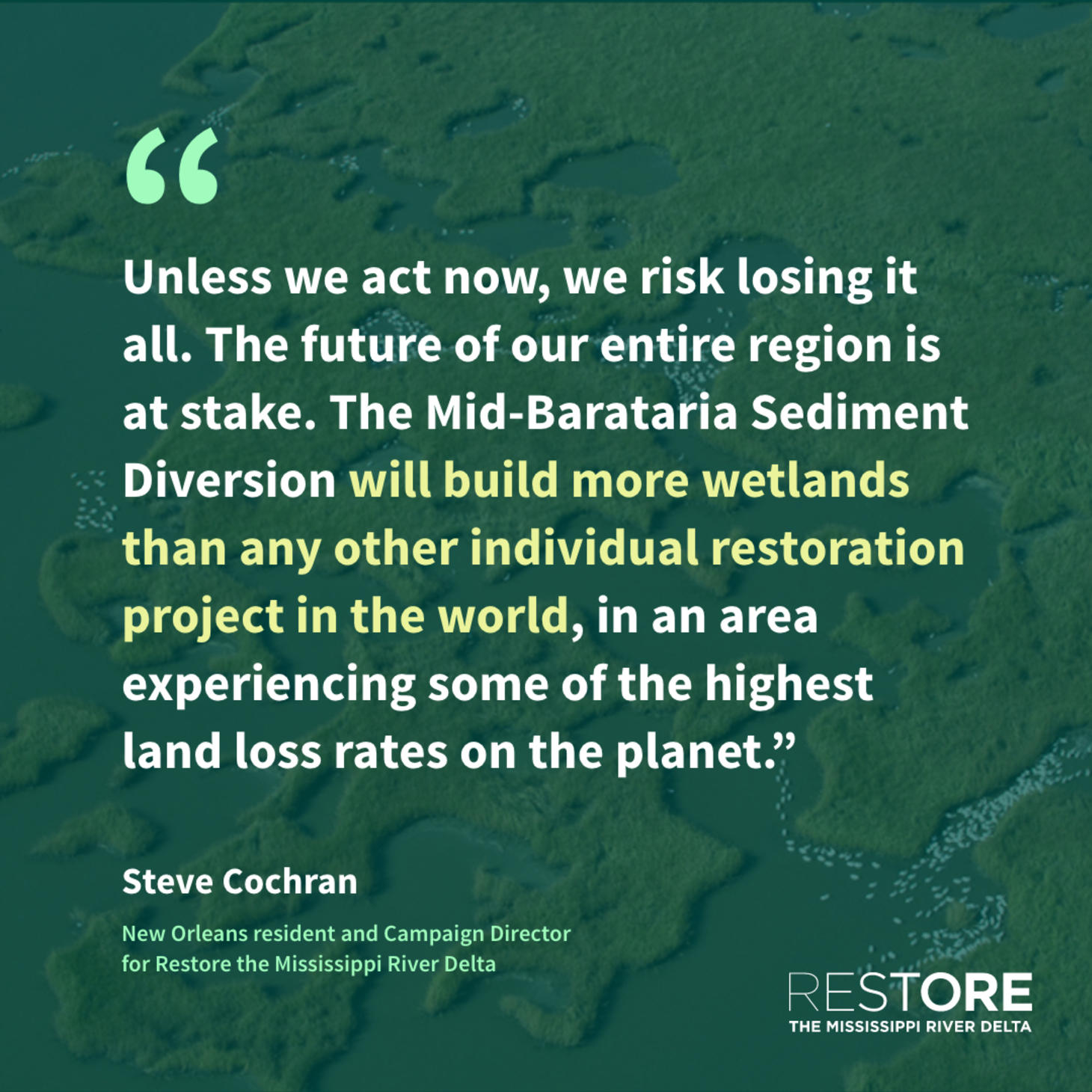
“Unless We Act Now, We Risk Losing It All”: Groups Underscore Importance of Mid-Barataria Sediment Diversion
MRD Press Release!
Using the Mississippi River to Restore Rapidly Vanishing Wetlands Vital to Future of Southeast Louisiana
Earned Media
This major Louisiana coastal project just received a positive report from the Corps of Engineers
One of the most expensive, ambitious and controversial projects in Louisiana’s 50-year, $50 billion bid to save the southern third of the state from disappearing like a modern-day Atlantis passed a major milestone Thursday night when the Army Corps of Engineers gave it a mostly positive assessment.
Four years in the making, the Corps' draft environmental impact statement found that the benefits of the Mid-Barataria Sediment Diversion - chiefly, creating and sustaining 28 square miles of marshes in the rapidly eroding Barataria Basin - more than outweigh the attendant disruption to oyster, brown shrimp and saltwater fisheries, and to bottlenose dolphins.
News
Freshwater diversion could hurt Barataria dolphin population
Quotes Dr. John Lopez: The freshwater may hurt the dolphin population in the short term, but one expert points out that’s not the whole story.
High ground, high prices
Still, experts say that the impact of climate change on the real estate market is only likely to become more pronounced. And while New Orleans and Miami are on the front lines of climate gentrification, the trend could repeat itself around the country as the impacts of our warming world grow more obvious.
New industrial growth in Louisiana's 'Cancer Alley' is 'environmental racism,' UN panel says
United Nations observers said this week that further industrialization in the Mississippi River corridor between Baton Rouge and New Orleans is a form of "environmental racism" against the area's Black residents and must be stopped despite past failures by the state and federal governments to halt its continued expansion.
'A big deal:' Jeff Landry to sign onto potential landmark settlement with oil and gas company
A potentially ground-breaking settlement with a major oil and gas company to help restore Louisiana’s disappearing coast will take a big step forward Thursday when Attorney General Jeff Landry publicly authorizes the agreement, said sources familiar with the deal.
The proposed $100 million settlement with Freeport McMoRan Inc. requires the signature of both Landry, a Republican, and Thomas Harris, the secretary of the Department of Natural Resources, representing Gov. John Bel Edwards, a Democrat. Harris has already signed it.
AG Jeff Landry signs agreement to settle 1 oil and gas lawsuit, faces criticism from industry
Attorney General Jeff Landry on Thursday authorized a $100 million settlement with an oil and gas company that has been accused in court of damaging Louisiana’s coast, but his decision immediately faced blowback from industry officials.
Landry said he signed the agreement with Freeport-McMoRan Inc. because the company wanted to settle its lawsuits and because the deal will help restore the disappearing coast.
AG Jeff Landry signs onto $100M settlement offer from Freeport -McMoran for its damage to Louisiana's coast - Louisiana Illuminator
A lawsuit pursuing financial restitution for damages by a petrochemical company to Louisiana’s natural storm buffer moved forward Thursday, when the state’s attorney general signed onto a $100 million settlement agreement.
For years, parishes have been pursuing lawsuits against oil and gas companies for ripping up the state’s wetlands, furthering the state’s coastal land loss and its vulnerability to future storms. A deal signed by Louisiana Attorney General Jeff Landry involving the petrochemical company, Freeport-McMoRan, could provide a blueprint for further coastal lawsuit settlements.
Plan to Rebuild Louisiana’s Vanishing Coast Moves Ahead
An environmental assessment said the project’s next step would largely benefit coastal areas, though it might also affect some marine life, especially dolphins.
Politico Morning Energy Newsletter
ANALYZE THIS: The Army Corps of Engineers is expected to release today a massive environmental impact statement for a Louisiana coastal project that environmental advocates say could pose a test case for how federal resource agencies grapple with efforts to restore ecosystems threatened by a changing climate.
The Mid-Barataria Bay diversion project would essentially cut a hole in the Mississippi River levees outside of New Orleans in a bid to restore the region’s fast-eroding marsh. It has been discussed for decades, and is set to be funded from the BP Deepwater Horizon spill settlement. But some interests have opposed the plan, fearing harm to fisheries, marine mammals and nearby communities. Green groups don’t dispute those impacts, but say that they’re a fraction of what will occur without the project since the ecosystem is under threat from sea-level rise and subsidence.