Earned Media
In New Orleans, Resilience and Innovation are Keys to Recovery
Features Steve Cochran, MRD/EDF and Dr. Alisha Renfro, NWF:
“If we don't do anything (to stop coastal land loss), we have to do something else, which is move. We have to pack up, and we have to move,” says Steve Cochran, associate vice president for coastal resilience with the Environmental Defense Fund, a foundation grantee. “(But) this is home. We're going to stay. We're going to make it livable. We're going to make sure it stays livable.”
“Sediment is the lifeblood of Louisiana,” adds Alisha Renfro, senior manager for coastal science policy with the National Wildlife Federation, a foundation grantee.
“It is what built the landscape … and it is the only thing that will actually sustain the coastal wetlands needed to protect communities over the long term.”
Guest column: River diversion important to Louisiana coast
Op-ed by Ted Falgout:
As a fourth generation Louisianaian living in the Barataria Basin for my entire life, some of my fondest memories involve trapping, hunting, fishing and alligatoring with my grandfather, father, siblings, and now my own sons and grandchildren. But this way of life and Louisiana’s bounty -- its fisheries, wildlife habitat, and abundant natural resources -- are at risk of complete collapse without large-scale coastal restoration projects like the Mid-Barataria Sediment Diversion.
These experiences have shaped my views on what it will take to address Louisiana’s very dire land loss crisis. Today, as a retiree, my “office” is now the basin as I get to enjoy full-time the natural treasures that have sustained me and my family for generations. I know that unless bold and aggressive measures are taken, future generations will not get to experience this bounty or live where we have lived unless we act with urgency and commitment. Both time and the tide are not on our side.
These experiences have shaped my views on what it will take to address Louisiana’s very dire land loss crisis. Today, as a retiree, my “office” is now the basin as I get to enjoy full-time the natural treasures that have sustained me and my family for generations. I know that unless bold and aggressive measures are taken, future generations will not get to experience this bounty or live where we have lived unless we act with urgency and commitment. Both time and the tide are not on our side.
These experiences have shaped my views on what it will take to address Louisiana’s very dire land loss crisis. Today, as a retiree, my “office” is now the basin as I get to enjoy full-time the natural treasures that have sustained me and my family for generations. I know that unless bold and aggressive measures are taken, future generations will not get to experience this bounty or live where we have lived unless we act with urgency and commitment. Both time and the tide are not on our side.
However, we have an opportunity to avoid this worst-case scenario. Louisiana has a resource that many other states, and even other regions of our own coast, would kill for – the Mighty Mississippi and its land-building sediment. This river built our great delta, producing an unparalleled abundance of natural resources, and it is our best hope of hanging onto all we know and love of our coast.
For decades, scientists and engineers have considered all the tools available and overwhelmingly agree the Mid-Barataria project is the best long-term solution necessary to match the challenges we face from land loss, sea level rise and climate change. No project that has the capability to be such a game changer will be without impacts, but these impacts can be managed and pale in significance to what is at stake if we squander this opportunity. A “future without action” would mean a future without South Louisiana, and that is something we owe to future generations.
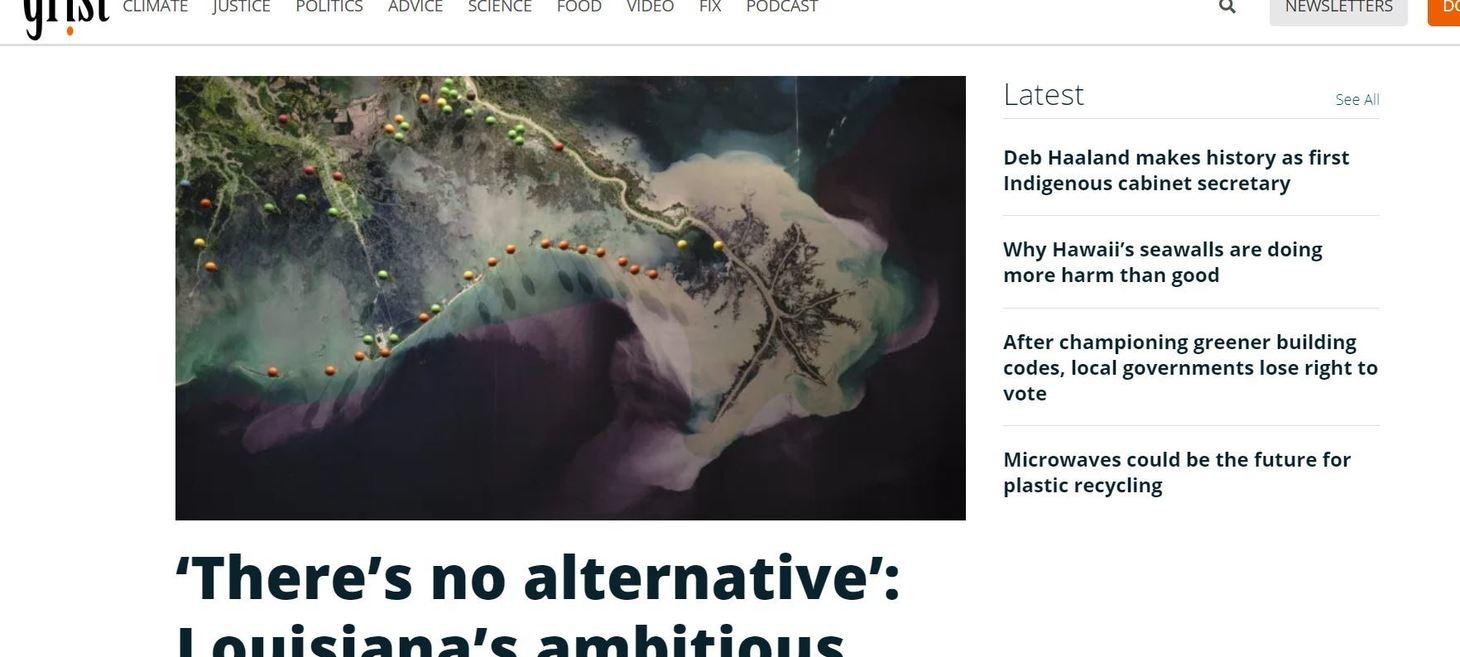
'There’s no alternative': Louisiana's ambitious plan to stay above water
Features Steve Cochran, MRD/EDF:
Slowing the rate of land loss in a state like Louisiana is easier said than done. As the ocean has risen, it has seeped into the delicate bayous that comprise the sole of the boot, flushing them with saltwater and killing the deep-rooted plants that keep the watery marshes from disintegrating. This slow seepage has cascading effects. It makes folks living along the coast more vulnerable to tropical storms, hurricanes, and storm surge. It threatens to wipe away huge swaths of Louisiana’s tourism industry and indigenous species of flora and fauna. And it will eventually force millions of Louisiana residents to flee their homes. The state could lose a third of its coast by 2050.
Counterintuitively, Louisiana plans to solve this problem using another body of water: the Mississippi River. State officials aim to harness the river’s unparalleled power to generate new land.
News
Newell: Largest Restoration Project In US History Has Serious Side Effects For Seafood And Other Industries
Newell talks to Save Louisiana Coalition President Capt. George Ricks about how stakeholders should interpret findings in the environmental impact statement for the Mid Barataria Sediment Diversion
Newell: What Does New Sediment Diversion Report Mean For Louisiana Fisheries?
Newell talks to Coastal Restoration and Protection Authority Chair Chip Kline about how stakeholders should interpret findings in the environmental impact statement for the Mid Barataria Sediment Diversion